
Yes, a business can sue for defamation. If someone publishes a false statement of fact about a company and it harms the company’s reputation, the company can go to court and ask for money, a correction, or both. This is called business defamation, and the company itself is usually the one that files.
Defamation means a false statement of fact, shared with other people, that damages a reputation. Winning a company defamation lawsuit is harder than most owners expect. You must prove four things: the statement was false and about your business, other people saw it, the speaker was at fault, and it caused real harm. A harsh review or an angry opinion usually doesn’t meet that test.
This guide covers which businesses can sue, what you must prove, how bad reviews fit in, what you can win, the deadline in every state, and what to do first. It focuses on United States law, with a short section on the UK, Canada, and Australia. It is general information, not legal advice.
Which businesses can sue for defamation?
Almost any business entity can. Corporations, LLCs, partnerships, and nonprofits count as legal “persons,” so they can sue and be sued in their own name. A sole proprietorship has no separate identity, so the owner brings the claim personally.
A company can only sue over harm to the company. It has no feelings, so it can’t claim embarrassment or emotional distress the way a person can. What it can claim is damage to its reputation, such as lost customers, cancelled contracts, and falling sales.

The owner or an employee may have a separate claim. Say a post reads, “Maria Lopez, the owner of Lopez Plumbing, steals from her customers.” Maria can sue for harm to her own name, and the company can sue for harm to the business. These are two different claims, and each depends on who the statement is really about.
What does a business have to prove?
A business claim has the same core parts as a claim brought by a person. In the United States, you generally need to show four things:
- A false statement of fact about your business. The statement must say something that can be checked and shown to be untrue. It must also be about you. Your business doesn’t have to be named, but readers must reasonably understand that it means you. A statement about a whole industry, like “all plumbers rip people off,” doesn’t point at any one company, so it usually fails.
- Publication. Someone other than you must have seen or heard it. A private message sent only to you doesn’t count. A public review, a social media post, an email to your customers, or a quote in a news story does.
- Fault. The speaker must have been at least careless about the truth. A private business usually only has to show negligence. If the statement involves a matter of public concern, many courts require proof of “actual malice” before awarding presumed or punitive damages. Public figures face that higher bar for every claim, covered below.
- Harm. The statement must have hurt the business, usually through lost money or lost opportunities.
Written defamation is called libel and spoken defamation is called slander. Online posts, videos, and podcasts blur that line, and what matters most is that you can prove each of the four parts.
Truth ends the case. If a statement is substantially true, it isn’t defamation, even if it costs you customers. A statement that is mostly accurate with a small slip in detail still counts as true.
Key takeaway: A business can sue only over false statements of fact that are clearly about it and that cause real harm. Opinions and true statements are not defamation, however much they sting.
Who can a business sue?
You can sue the person or company that published the statement. That might be a customer, a competitor, a former employee, a blogger, or a news outlet. If several people repeated the statement, each one can be named, although the original speaker is usually the main target.

Competitors are a common case. A rival who lies about your prices, your safety record, or your legal trouble can face a defamation or trade libel claim, and false advertising or unfair competition laws may also apply. Former employees are another. They may share what they honestly know, which is protected, or they may invent things, which isn’t.
Websites and social media platforms are different. Because of Section 230, you generally can’t sue them for what a user posted. You can still ask them to remove it if it breaks their rules.
Which statements count as defamatory?
Facts can be defamatory. Opinions usually can’t. “The food was cold and the service was slow” is a customer’s honest experience. “This restaurant has rats in the kitchen” is a statement of fact, and it can be checked.
The line isn’t always clean. Calling a contractor “the worst I’ve ever hired” is opinion. Calling a contractor “a scammer who takes deposits and disappears” suggests a fact, and a court may treat it that way if it’s false. Judges look at how an ordinary reader would take the words in context.
Some false statements are so damaging to a business that many states treat the harm as obvious. This is often called defamation per se, and it can spare you from proving exact dollar losses. Typical examples are false statements that a business:
- committed a crime or fraud
- is bankrupt or about to fail
- cheats its customers
- lacks a license it needs to operate
- sells unsafe products
Rules differ by state, so check how yours handles these. The table below shows how the fact-versus-opinion line usually plays out.
| Statement about a business | Fact or opinion | Likely result |
| “The owner was arrested for fraud” (false) | Fact | Strong claim |
| “They don’t hold a state license” (false) | Fact | Strong claim |
| “They never refunded me” (they did) | Fact | Possible claim |
| “Overpriced for what you get” | Opinion | Probably not defamation |
| “Worst service I’ve ever had” | Opinion | Probably not defamation |
What is the difference between defamation and trade libel?
Defamation attacks the reputation of the business itself. Trade libel, also called injurious falsehood or product disparagement, attacks its products or services.
“This company is run by crooks” goes after the business’s character, which points to defamation. “This brand’s space heater catches fire” goes after the product. If that second statement is false and costs you sales, trade libel may fit.
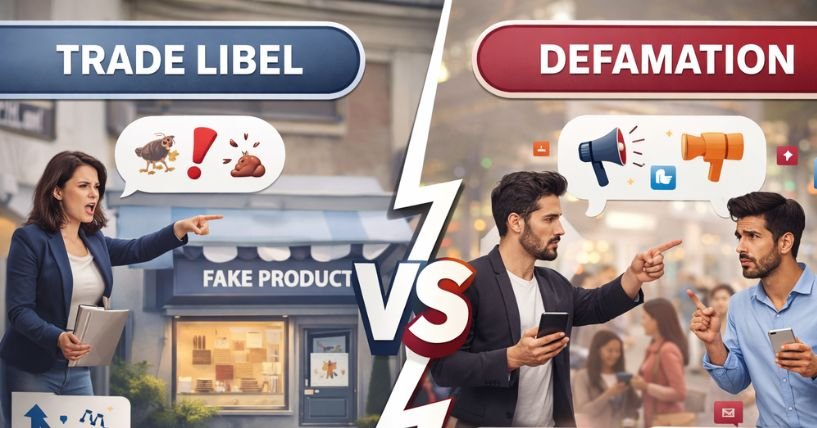
Trade libel is often harder to prove. You usually need to show specific financial loss, such as named customers who walked away because of the statement, and you often need to show the speaker knew it was false or didn’t care. Some businesses bring both claims in one case. A lawyer can tell you which fits your facts.
Can a business sue for a bad review?
Sometimes, but not often. A review is protected when it’s an honest opinion about a real experience. It can be defamatory when it states false facts, such as describing a service that never happened, accusing the business of a crime, or coming from someone who was never a customer.
Four points shape these cases.
- Customers can post honest reviews. The Consumer Review Fairness Act bars companies from using standard-form contract terms that block or punish honest reviews. Those contracts can still restrict reviews that are libelous, harassing, abusive, clearly false or misleading, or that reveal private information. A review you simply dislike doesn’t qualify.
- You sue the reviewer, not the platform. Section 230 of the Communications Decency Act generally shields websites such as Google, Yelp, and Facebook from liability for what their users post.
- Anonymous reviewers are hard to reach. You may need a court order to make a platform reveal who wrote a review, and courts often want to see a real claim before they allow it.
- The damage has to be real. One bad review with no way to link it to lost sales makes a weak case.
Before you try to sue for a bad review, report it to the platform as false or against its rules, and reply in a calm, factual tone. That is faster and cheaper, and it often works. Threatening a customer over an honest review can also backfire in public and cost you more than the review did.
[INSERT: a short, anonymized client example or a quote from the reviewing attorney about a review case.]
Does a well-known business face a higher standard?
It can. The First Amendment sets a higher bar for public figures. If a court treats your business as a public figure, you must prove “actual malice,” a rule set in New York Times v. Sullivan. It means the speaker knew the statement was false or didn’t care whether it was true. That is far harder to prove than simple carelessness.

A small local shop is almost always a private business. A company that is widely known, or that has stepped into a public debate, may be treated as a public figure for that debate. Courts decide this case by case, so it’s worth asking a lawyer early.
The payoff can be large when a claim clears the bar. In 2023, Fox News agreed to pay Dominion Voting Systems $787.5 million to settle a defamation case over on-air statements about the company’s voting machines. Few business cases come anywhere near that size, but it shows what a strong claim can be worth.
What can a business win in a defamation case?
If you win, the court can award several kinds of relief.
- Compensatory damages. Money for the losses the statement caused, such as lost sales, cancelled contracts, lost deals, and the cost of repairing your reputation.
- Punitive damages. In some states, extra money meant to punish a speaker who acted with malice.
- An injunction. A court order to take the statement down or stop repeating it, usually only after the court finds it false.
- A retraction or apology. Often part of a settlement rather than a court order.
Proof of loss is where many cases are won or lost. Common evidence includes sales figures from before and after the statement, messages from customers who said why they left, cancelled contracts, and sometimes an expert who can estimate lost profits.
Many cases settle before trial. A typical deal includes a takedown, a correction, and sometimes a payment. The threat of a well-prepared lawsuit is often what gets that result.
Defamation statute of limitations: how long do you have?
Deadlines are short. Defamation has one of the shortest filing windows in civil law. Most states allow one or two years from publication, and a handful allow three. Tennessee is the shortest, at six months for slander. In most states the clock starts when the statement is first published, not each day it stays online. Miss the deadline and the claim is gone, however strong it was.

| Deadline | States |
| 6 months (slander) / 1 year (libel) | Tennessee |
| 1 year | Arizona, California, Colorado, District of Columbia, Georgia, Illinois, Kansas, Kentucky, Louisiana, Maryland, Michigan, Mississippi, Nebraska, New Jersey, New York, North Carolina, Ohio, Oklahoma, Oregon, Pennsylvania, Texas, Utah, Virginia, West Virginia, Wyoming |
| 2 years | Alabama, Alaska, Connecticut, Delaware, Florida, Hawaii, Idaho, Indiana, Iowa, Maine, Minnesota, Missouri, Montana, Nevada, North Dakota, South Carolina, South Dakota, Washington |
| 3 years | Massachusetts, New Hampshire, New Mexico, Vermont, Wisconsin |
| 1 year (slander) / 3 years (libel) | Arkansas, Rhode Island |
These are general limits. Exceptions exist for things like claims against government bodies, and some states also require a retraction demand before you can seek certain damages. Confirm your state’s current rule in its code or with a lawyer before you rely on any date.
What should you do first?
Here is a sensible order of steps:
- Save the evidence. Take dated screenshots and copy the web address before anything is deleted or edited.
- Check whether it’s true. Be honest with yourself. If part of the statement is accurate, your claim is weaker.
- Write down the harm. List lost customers, cancelled orders, and any drop in revenue after the date of publication.
- Look up your deadline. Find your state’s time limit in the table above and mark it on a calendar.
- Talk to a lawyer. Ask for a defamation or business litigation attorney. A cease-and-desist letter or retraction demand often ends the problem without a lawsuit.
If you decide to send a demand letter, keep it short and factual. Quote the exact statement, say why it is false, list the harm it caused, and ask for a clear action, such as removing the post or publishing a correction. Give a firm deadline. Keep the tone calm, because the letter may be read by a judge later.
What defenses and risks should you weigh before suing?
The person you sue will have defenses. The main ones are truth, opinion, and privilege. Privilege protects certain statements no matter what, such as those made in court filings or official government proceedings.
Most states also have anti-SLAPP laws. These let a defendant ask the court to dismiss a lawsuit early if it targets speech on a public issue. If the defendant wins, the business may have to pay their legal fees. That risk is real when a business sues over criticism.

Other costs add up too. Lawsuits take time and money. The other side can demand your records through discovery, including customer complaints and financial data. And suing a customer or critic can draw far more attention to the statement than it ever had on its own.
Weigh the likely payout against all of this. If the statement is false, clearly about you, and has cost you real money, a claim can be worth the effort. If it’s a sharp opinion with little measurable harm, a public reply is usually the better move.
Can a business sue for defamation outside the United States?
The rules change a lot from country to country. In England and Wales, section 1 of the Defamation Act 2013 says a business that trades for profit must show that the statement caused or is likely to cause serious financial loss. In Australia, most companies can’t sue at all.
| Country | Can a business sue? | Key rule |
| United Kingdom (England and Wales) | Yes | A for-profit company must show serious financial loss. The usual time limit is one year. |
| Canada | Yes | Companies can sue under common law and provincial law. Details vary by province, and some, such as Ontario, require written notice within weeks when suing a newspaper or broadcaster. |
| Australia | Only some | Only not-for-profits and companies with fewer than 10 employees that are not related to another company can sue. A concerns notice must be sent first, and the time limit is generally one year. |
In Australia, the owner of a larger company can still sue personally if the statement is about them. If your business operates outside the US, get advice from a lawyer in that country before you act.
Frequently asked questions
Can a business sue for defamation over a Google review?
Yes, if the review states false facts and caused real harm. An honest opinion is protected. You would sue the reviewer, not Google, because Section 230 generally shields platforms from claims over what their users post.
Can a business owner sue for defamation personally?
Yes, if the statement is about the owner and harms their own reputation. The owner and the company can have separate claims. A sole proprietor has no separate business identity, so the owner sues in their own name.
Does a business have to prove it lost money?
Often, yes. Records that tie lost sales to the statement are the best proof. Some states treat certain false statements, like accusing a business of fraud or a crime, as harmful on their own, which can ease that burden.
Can a business sue a competitor for lying about it?
Yes. A competitor’s false statements can support a defamation or trade libel claim. In the United States, false advertising or unfair competition laws may also apply. A lawyer can tell you which claims fit your facts.
How long does a business have to sue for defamation?
In the United States, most states allow one or two years from publication, and a handful allow three. Tennessee allows six months for slander. See the state table above. Other countries have their own limits, and the UK and Australia generally allow one year.
Conclusion
Yes, a business can sue for defamation when someone publishes a false statement of fact that is clearly about it and causes real harm. Opinions, honest reviews, and true statements don’t qualify. The strongest cases rest on saved evidence, clear financial losses, and a fast start, since most states allow only one or two years. Before you file, check your state’s deadline, talk to a lawyer, and try a takedown request or demand letter first.
Recommended Articles:
How to Sell Food From Home: A Step-by-Step Guide for the US
Does 19thstategroup.com Have a Blog? What You’ll Find Instead
Reporting Global News InterWorldRadio: The Complete Guide to Modern International Journalism
FTAsiaManagement Tech – Driving Innovation in Business Management Across Asia!



[…] Can a Business Sue for Defamation? What You Must Prove […]
[…] Can a Business Sue for Defamation? What You Must Prove […]