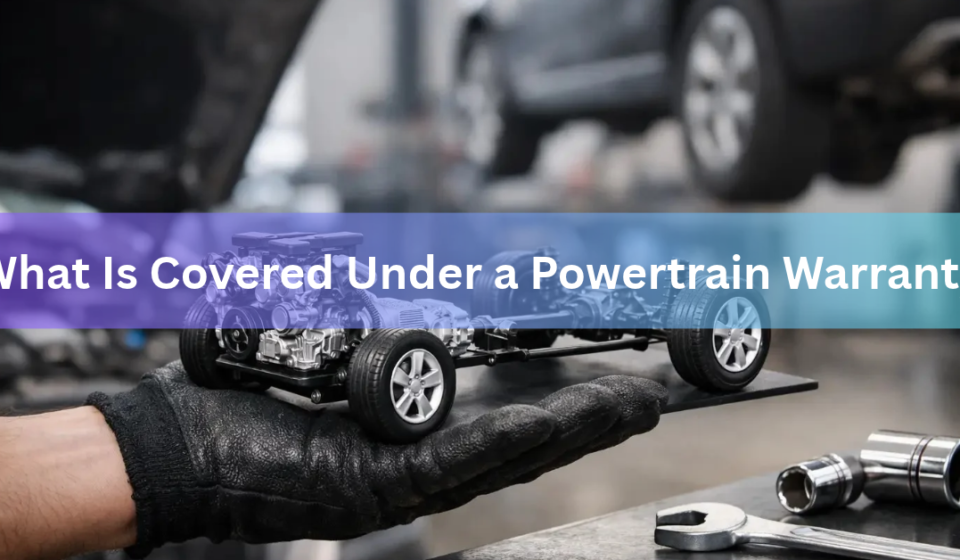

A powertrain warranty covers the parts that make your car move. That means the engine, the transmission, the transfer case (on all-wheel and four-wheel drive), the driveshaft, the differential and the axles. If one of these parts fails because it was built wrong, the maker repairs or replaces it at no cost to you, as long as the car is inside the time and mileage limit.
That is the short answer. The details matter, because the same warranty leaves out wear parts, damage from outside causes, and anything that does not help drive the wheels. Below you will find what is covered, what is not, how long coverage lasts, how it works on hybrids and electric cars, and what to do when something breaks.
Simple rule: if a part makes power or sends power to the wheels, it is likely covered. If it wears out from normal use, or has nothing to do with moving the car, it is likely not.
What is the powertrain in a car?
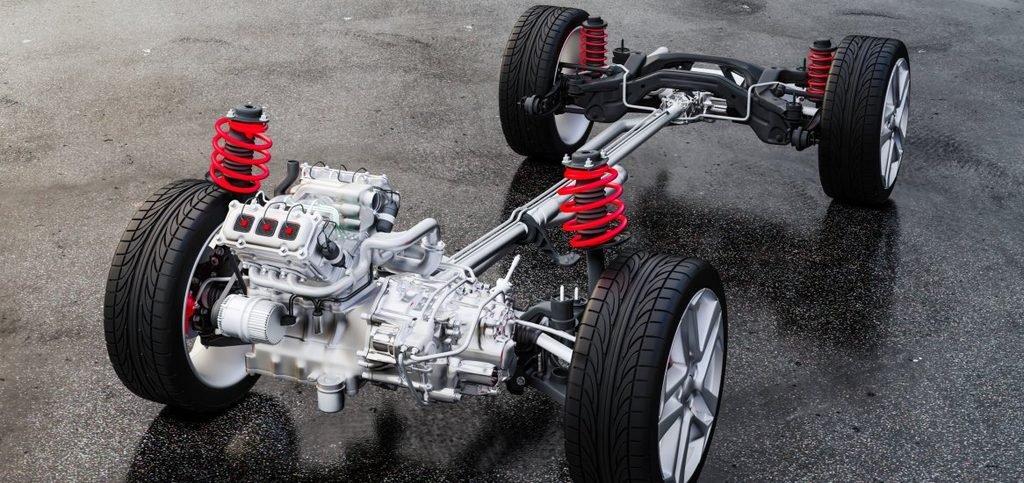
The powertrain is the chain of parts that creates power and delivers it to the road. Follow the path from front to back: engine, transmission, driveshaft, differential, axles, wheels.
The engine burns fuel and makes power. The transmission turns that power into the right speed and force for the road. It does this with gears or, in many newer cars, with a pulley system called a continuously variable transmission (CVT). On all-wheel and four-wheel drive vehicles, a transfer case splits the power between the front and rear axles.

The driveshaft is a spinning rod that carries power from the transmission to the differential. The differential lets the outside wheel spin faster than the inside wheel when you turn. On front-wheel-drive cars, the transmission and differential share one housing called a transaxle. The axles are the shafts that turn the wheels.
You will also hear the word drivetrain. It means the same chain, minus the engine.
What does a powertrain warranty cover?
A powertrain warranty pays to fix or replace the working parts inside each of these units when they fail from a defect in materials or factory workmanship. Your warranty booklet has the exact list, but the coverage follows the same path as the powertrain itself.
The engine
The engine is the most expensive part of the powertrain, so it is the part most owners worry about. Coverage reaches the big internal pieces, such as the cylinder block, the cylinder heads and the valvetrain (the parts that open and close the engine’s valves). It also reaches the flywheel, the oil pan, and the gaskets and seals that keep fluids in.
Many warranties name the oil pump, water pump, fuel pump and fuel injectors as well. Others leave some of them out. The wording changes from brand to brand, so check the list in your own booklet.
The transmission and transaxle
Automatic, manual and CVT transmissions are all covered. So is the transaxle on a front-wheel-drive car. Chevrolet’s warranty, for one, names the case, every internal part that sits in lubricant, and the seals and gaskets. A failed internal part caused by a factory defect is the classic covered repair.
The transfer case, driveshaft, differential and axles
On all-wheel and four-wheel drive vehicles, the transfer case is covered along with its internal parts. The driveshaft, the differential and the axle shafts are covered too. On many brands the bearings and universal joints inside the drive system are included.
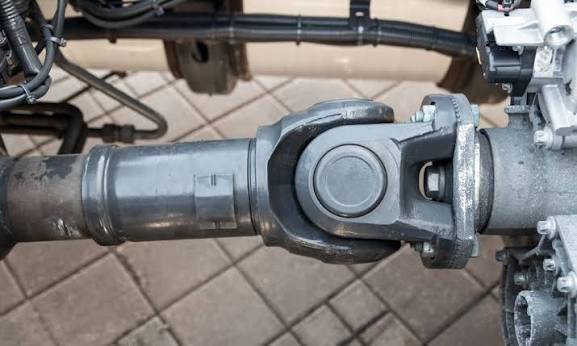
Constant velocity (CV) joints, the flexible joints at the ends of the axle shafts, are a gray area. Some brands cover them. Others treat them as wear parts and leave them out. Look for CV joints by name in your booklet, and do the same for the timing belt, which also gets different treatment from one maker to the next.
What is not covered by a powertrain warranty?
A powertrain warranty covers defects. It does not cover normal wear or damage from outside causes. The exclusions fall into a few clear groups:
- Wear items: parts that wear out by design, such as spark plugs, filters, fluids, brake pads, belts, hoses, batteries and the clutch on a manual car. Oil changes and tire rotations are your cost.
- Parts that do not drive the car: air conditioning, steering, suspension, brakes, infotainment, lighting and most electronics. These fall under the basic warranty, if they are covered at all.
- Sensors, wiring and connectors: these are often excluded even when they sit on the engine or transmission.
- Outside causes: crashes, floods, hail, storms, bad or dirty fuel, and misuse such as racing or overloading the vehicle.
- Neglect: if the service schedule in your owner’s manual was not followed, a claim can be denied.
- Changes to the car: an aftermarket part or modification that causes the failure.
Here is a simple way to think about it. A transmission that fails at 40,000 miles because of a bad internal part is a defect, so the maker pays. A clutch that wears out at 40,000 miles from normal use is wear, so you pay.
Collision damage goes to your car insurance, not the warranty. Insurance pays for accidents, storms and theft. A warranty pays for mechanical failures that happen during everyday use.
How long does a powertrain warranty last?
Most new-car powertrain warranties last 5 years or 60,000 miles, whichever comes first. A few brands go much further. Hyundai, Kia, Genesis and Mitsubishi offer 10 years or 100,000 miles.
| Brand | Powertrain warranty | Basic (bumper-to-bumper) |
| Hyundai | 10 years / 100,000 miles | 5 years / 60,000 miles |
| Toyota | 5 years / 60,000 miles | 3 years / 36,000 miles |
| Honda | 5 years / 60,000 miles | 3 years / 36,000 miles |
| Nissan | 5 years / 60,000 miles | 3 years / 36,000 miles |
| Chevrolet | 5 years / 60,000 miles | 3 years / 36,000 miles |
| Ford | 5 years / 60,000 miles | 3 years / 36,000 miles |
| Lexus | 6 years / 70,000 miles | 4 years / 50,000 miles |
The words “whichever comes first” matter. If you drive 20,000 miles a year, you will reach 60,000 miles in three years, and coverage ends then, even though the time limit says five. The clock starts the day the car is first sold or leased, not the day you buy it second-hand.
Luxury brands vary more. Acura, Cadillac and Lincoln are among those that give 6 years or 70,000 miles. Mercedes-Benz and BMW cover the powertrain for 4 years or 50,000 miles as part of their main factory warranty. Some luxury brands set no mileage limit at all, so coverage ends only when the years run out. Tesla covers its battery and drive unit for 8 years, with a mileage cap of 100,000 to 150,000 miles depending on the model.
Check your own model year. Brands change their terms now and then, so confirm the years and miles in your warranty booklet before you rely on any figure in this guide.
How is a powertrain warranty different from a bumper-to-bumper warranty?
The bumper-to-bumper warranty is the maker’s basic warranty. It covers most of the car, including electronics, air conditioning, power steering and infotainment, plus suspension and brake parts that fail from a defect. The name is only a nickname. It still leaves out tires, light bulbs, fuses and normal wear items.
The powertrain warranty is narrower but lasts longer. Hyundai gives 10 years or 100,000 miles on the powertrain and 5 years or 60,000 miles on the basic warranty. Ford gives 5 years or 60,000 miles on the powertrain and 3 years or 36,000 miles on the basic one. In the fourth year of a Ford’s life, the basic warranty is over, but the powertrain warranty still has a year to run.
You may also meet a drivetrain warranty, mostly on plans sold separately. It covers everything in the powertrain except the engine. Because the engine is the costliest part, a drivetrain plan often costs less and protects less.
Does a powertrain warranty cover hybrids and electric cars?
Yes, but the parts are different. An electric car has no engine and no multi-gear transmission. Its powertrain is the electric motor or motors, the inverter (which controls the power sent to the motor) and the gears that turn the wheels. Many makers bundle the battery pack into the same coverage, which is why you will often see it called a battery and drive unit warranty.
The high-voltage battery nearly always has its own, longer warranty. In the US, federal rules require at least 8 years or 100,000 miles on the battery of an electric car. California requires a longer term, 10 years or 150,000 miles, for certain vehicles, and some other states follow California’s rules. Hyundai and Kia give 10 years or 100,000 miles on EV batteries, and Rivian goes up to 8 years or 175,000 miles on some models.
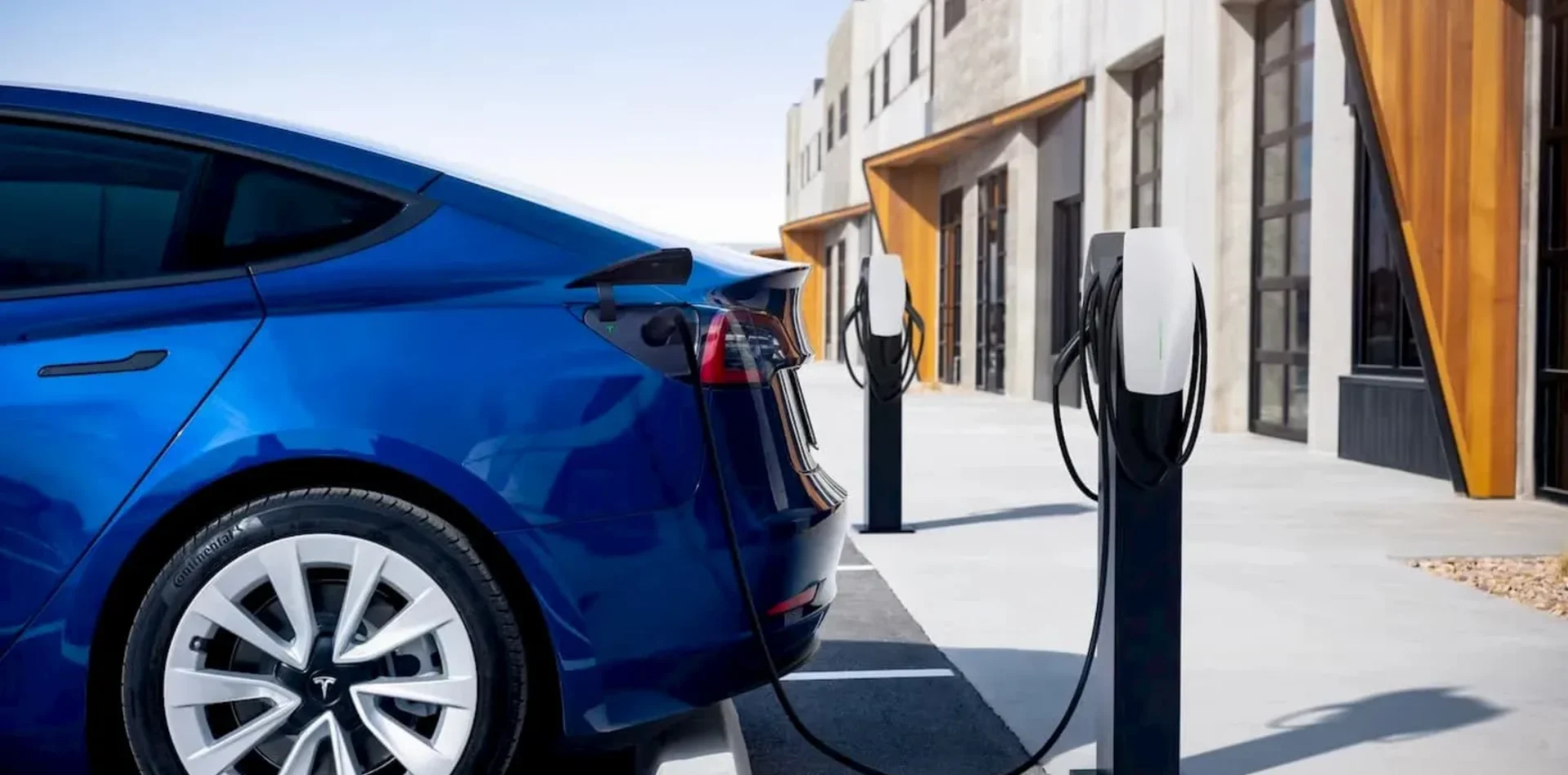
Most battery warranties also promise a minimum capacity, often 70 percent. Tesla, for example, guarantees at least 70 percent over the warranty period. A battery that loses a little range with age but stays above the promised level is not a warranty claim. One that drops below it, or fails outright, is.
This is the coverage worth reading closely. Outside warranty, replacing an EV battery can cost anywhere from $15,000 to well over $20,000. The small 12-volt battery that runs the lights and accessories is a different part. It sits under the basic warranty, not the EV battery warranty.
Does a powertrain warranty transfer to the next owner?
In most cases, yes. Any factory powertrain coverage left on the car passes to the next owner when you sell or trade it in. Some brands cut the coverage when the car changes hands, though.
Hyundai is the clearest example. Its 10-year/100,000-mile powertrain warranty applies to the original owner only. Second and later owners get 5 years or 60,000 miles, counted from the date the car first went into service. Say you buy a Hyundai that is 2 years old with 40,000 miles. You would have 3 years or 20,000 miles of powertrain coverage left, whichever ends first.
Certified pre-owned (CPO) programs can change the picture. Many add their own powertrain coverage, and some offer longer terms than a second owner would otherwise get. If you are buying used, ask for the exact terms in writing and look at the car’s service history.
Do you have to service the car at the dealer to keep the warranty?
No. A federal law called the Magnuson-Moss Warranty Act makes it illegal for a maker or dealer to void your warranty, or deny a claim, only because someone other than the dealer did the work. You can use an independent shop or a chain, or do routine jobs yourself. Using an aftermarket part does not void the warranty either.
There is one limit. If the work or the part causes the failure, the maker can deny that repair. Say a belt is fitted wrongly and the engine is damaged. The maker does not have to pay for the engine damage, but it must be able to show that the belt job caused it. The rest of your warranty stays in force.

The practical step is to keep records. Save receipts for every oil change, fluid service and inspection, no matter who did the work, and follow the service schedule in your owner’s manual. If a claim ever comes up, that paper file shows the car was looked after. The FTC’s consumer guide to auto warranties, maintenance and repairs explains these rights in plain language.
One more point: the warranty repair itself is a different matter from routine service. Covered repairs go to an authorized dealer for your brand, because the maker will not pay an independent shop for them.
How do you make a powertrain warranty claim?
Claims are simple when your paperwork is in order. Follow these steps:
- Check your limits. Look up the years and miles in your warranty booklet and see how close you are. If you notice a problem near the end of coverage, get it checked before the limit passes.
- Book the car in at an authorized dealer for your brand. Describe the symptoms: the noise, the warning light, the shift problem, and when it happens.
- Bring your service records. Receipts for oil changes and other scheduled work show the car was maintained.
- Ask for a written repair order that lists your complaint and what the technician found. Keep your copy.
- If the claim is denied and you think that is unfair, ask to speak with a supervisor. You can then contact the manufacturer directly or try another dealer. You can also file a complaint with your state attorney general, a local consumer protection office or the FTC.
Is extra powertrain coverage worth buying?
It depends on how long you will keep the car. If you plan to sell or trade it in before the factory coverage ends, you already have what you need. If you will drive well past 60,000 miles, or you are buying a used car with no factory coverage left, extra protection can make sense, because the powertrain is the costliest part of a car to fix.
Prefer a plan backed by the carmaker. If you look at third-party plans, read the fine print. Check which parts are named, whether there is a deductible, who does the repairs, and how claims get approved.

Lifetime powertrain warranties sold by dealers need extra care. They are separate from the maker’s warranty, and the dealer must do the covered repairs. They may demand a stricter maintenance schedule than the maker asks for, limit use such as towing, and leave out seals and gaskets.
Frequently asked questions
Does a powertrain warranty cover a blown engine?
Yes, if the failure comes from a defect in a covered part and the car is inside the time and mileage limit. The claim can be denied if the damage came from missed maintenance, misuse, an accident or a wrongly fitted part.
Does a powertrain warranty cover oil changes and other maintenance?
No. Oil changes, filters, fluids, spark plugs, brake pads and tire rotations are your cost. The warranty pays for defects, not routine care. You still need to do the scheduled service, because skipped maintenance can lead to a denied claim.
What is the difference between a powertrain and a drivetrain warranty?
A powertrain warranty covers the engine plus the parts that carry power to the wheels. A drivetrain warranty covers the same parts except the engine. Because the engine is the costliest part, drivetrain plans often cost less and protect less.
What voids a powertrain warranty?
Damage from crashes, floods, misuse, racing or overloading is excluded, and so is a failure caused by skipped maintenance or a faulty aftermarket part. Using an independent shop or an aftermarket part does not void the warranty on its own.
Does a powertrain warranty cover labor costs?
A factory powertrain warranty pays for a covered repair or replacement at no extra charge to you, which includes parts and labor. Plans sold separately may charge a deductible, so check the terms before you buy.
Conclusion
A powertrain warranty covers the engine, transmission, transfer case, driveshaft, differential and axles when they fail from a defect. Most last 5 years or 60,000 miles, and some brands go to 10 years or 100,000 miles. It does not cover wear parts, accidents or neglect. Read your booklet, keep every service receipt, and take covered repairs to an authorized dealer. Do that, and a covered failure costs you nothing.
Recommended Articles:
Medical Transportation Business Income: How Much per Month?
How to Sell Food From Home: A Step-by-Step Guide for the US
Does 19thstategroup.com Have a Blog? What You’ll Find Instead
The Interworldradio Blog – A Complete Guide for Readers and Writers!
Medical Transportation Business Income: How Much per Month?



[…] What Is Covered Under a Powertrain Warranty? […]
[…] water do not leave spots. A coating warranty is separate from your car’s own cover, such as a powertrain warranty, and it often asks for regular care and inspections. Read its terms before you try a new […]