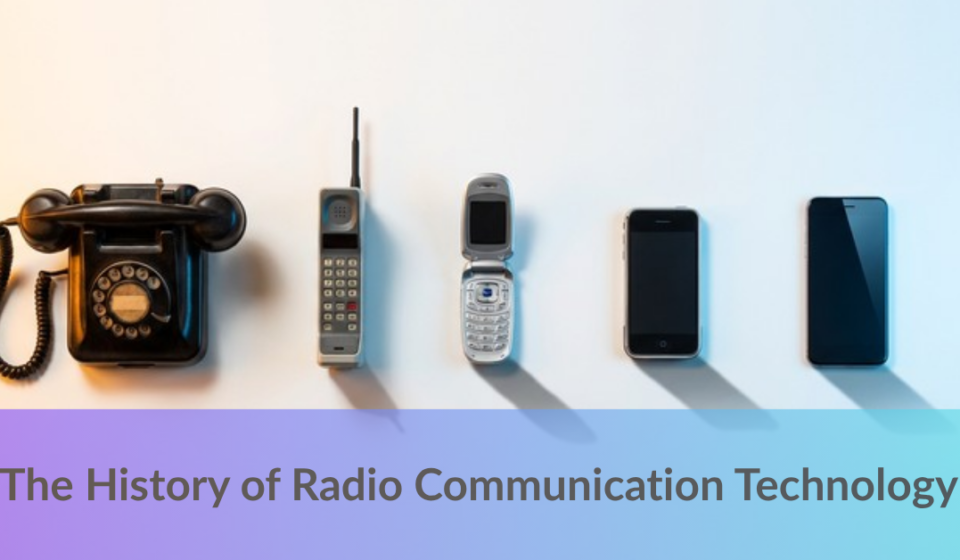

Radio communication began as physics in the 1860s and 1880s, became a working wireless telegraph in the 1890s, learned to carry voice and music between 1900 and 1920, and has been moving from analog to digital since the 1990s. Every step used the same thing: invisible electromagnetic waves that travel at the speed of light and need no wire.
This guide follows that path in order. You’ll see who built what, when it happened, and why each step mattered. A short timeline comes first, then the full story.
Radio history at a glance
| Year | What happened |
|---|---|
| 1886–1888 | Heinrich Hertz creates and detects radio waves in his lab |
| 1895 | Guglielmo Marconi’s test signals travel about half a mile |
| 1901 | First radio signal crosses the Atlantic, from Cornwall to Newfoundland |
| 1904 | John Ambrose Fleming invents the vacuum tube diode |
| 1906 | Reginald Fessenden broadcasts voice and music; Lee de Forest builds the Audion |
| 1912 | The Titanic sinks and the Radio Act sets a 24-hour distress watch |
| 1920 | KDKA in Pittsburgh begins scheduled broadcasts |
| 1933 | Edwin Armstrong patents FM radio |
| 1954 | The Regency TR-1 becomes the first commercial transistor radio |
| 1995 | Digital Audio Broadcasting (DAB) starts in Norway, then the UK and Sweden |
| 2001–2002 | Satellite radio and HD Radio launch in the United States |
What is radio communication?
Radio communication is a way to send information through the air by shaping an invisible wave. A system has three parts: a transmitter that makes the wave, the wave itself, and a receiver that turns it back into sound, text, or data.
The sender changes the wave in a way the receiver can read. Early systems switched it on and off to form Morse code. Later systems changed its strength (AM) or its frequency (FM) to copy a voice. Modern systems change it to send streams of digital code. The rest of this history is the story of those changes.
Radio waves are described by their frequency, which is how many times the wave swings up and down each second. One swing per second is one hertz. AM stations in the United States broadcast at roughly 500 to 1,700 kilohertz, and FM stations at about 88 to 108 megahertz, which means millions of swings per second.
How did radio begin?
Radio began with a theory. In the 1860s the Scottish physicist James Clerk Maxwell worked out that electric and magnetic fields could travel through space as waves, and that light was one kind of them. Nobody had shown that any other kind existed.

Heinrich Hertz, a German physicist, tested the idea at Karlsruhe between 1886 and 1888. He used a spark to make rapid electrical swings, then caught them with a wire loop across the room. A tiny spark in the loop proved the waves had crossed the gap. He also measured their speed and found it matched the speed of light.
Hertz himself saw no practical use for the work. Even so, it opened the door. For a while the waves were called Hertzian waves, and around 1910 the word “radio” took over. Today the unit of frequency, the hertz, carries his name.
Who turned radio waves into a way to communicate?
Several people worked on wireless signals at the same time in the 1890s. Nikola Tesla gave public demonstrations of wireless transmission in 1893. Oliver Lodge showed how to send and detect signals in his 1894 lectures in Britain. Alexander Popov presented a receiver to a Russian scientific society on May 7, 1895, a date Russia now marks as Radio Day.
Early receivers relied on the coherer, a small glass tube of metal filings that conducted electricity when a radio wave hit it. Édouard Branly in France improved this device in the mid-1880s.
Guglielmo Marconi, a young Italian inventor, turned these parts into a business. In August 1895 his test signals reached about half a mile. He kept improving his antennas and receivers. On December 12, 1901, Marconi and his assistant George Kemp heard three faint clicks, the Morse code letter S, sent from Poldhu in Cornwall to Signal Hill in Newfoundland. They used a wire antenna held up by a kite, and the signal covered more than 2,000 miles. The Poldhu transmitter was built with help from the engineer John Ambrose Fleming. Later research showed that radio waves can bounce off a high layer of the atmosphere called the ionosphere, which is how a signal can follow the curve of the Earth. You can read the details on the IEEE history page for the 1901 transatlantic signal.
A reliable transatlantic service followed on October 17, 1907, between Clifden, Ireland, and Glace Bay, Nova Scotia. Marconi shared the 1909 Nobel Prize in Physics with the German physicist Karl Ferdinand Braun for their work on wireless telegraphy.
This first era is called wireless telegraphy. It carried no voice. A spark transmitter made bursts of noise, and operators tapped out Morse code, which is a code of short and long signals. Ships became the first big customers, because they could not use telegraph wires.
How did radio learn to carry voice and music?
A spark transmitter makes noise, not smooth sound, so voice needed a new approach. Reginald Fessenden, a Canadian inventor working in the United States, built a transmitter that sent a steady, continuous wave. He varied its strength to match the shape of a sound wave. This method is called amplitude modulation, or AM.
On December 23, 1900, he sent his voice about a mile between two masts on Cobb Island, Maryland. On Christmas Eve 1906, from Brant Rock, Massachusetts, he sent a short program of music, a violin solo of “O Holy Night,” and a Bible reading to radio operators on ships in the Atlantic. Many of them had only ever heard Morse code.
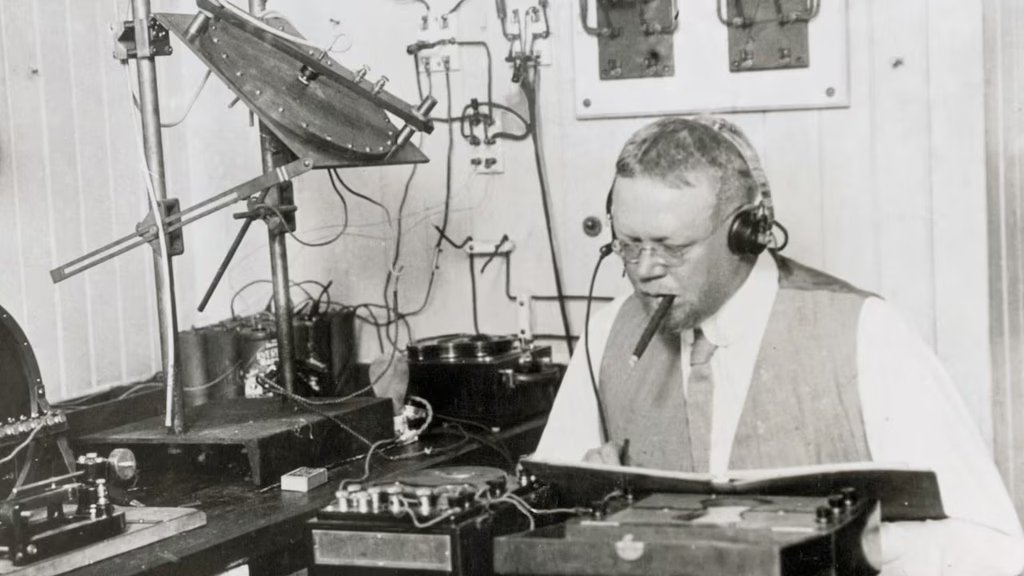
Better parts made this practical. In 1904 the British engineer John Ambrose Fleming built a two-element vacuum tube that could detect radio signals. In 1906 the American inventor Lee de Forest added a third element, a metal grid, and called his tube the Audion. The grid let the tube boost a weak signal into a strong one.
Amplification changed everything. It let receivers pick up faint, distant stations, and it let transmitters send clear speech. By 1916, a station run by de Forest’s company was airing election night results by voice.
Why did the Titanic change how radio is used?
The Titanic showed the world that radio saves lives, and that it needs rules. The United States had already passed the Wireless Ship Act in 1910, which required wireless equipment on major passenger ships. But on the night of April 14, 1912, the Titanic’s operators, Jack Phillips and Harold Bride, were busy with passengers’ messages, and ice warnings were missed. Both worked for the Marconi Company rather than the ship’s owner.
After the ship hit an iceberg, its distress calls brought the Carpathia, which rescued more than 700 people. Four months later, the Radio Act of 1912 required ships to watch distress frequencies around the clock. It also required amateur radio operators to hold licenses.
When did radio broadcasting begin?
World War I slowed everything down. In 1917 the U.S. government ordered amateur stations off the air, and thousands of amateur operators served the Army and Navy instead. When the war ended, those trained operators and the new vacuum tube technology were ready for civilian use.
Scheduled commercial broadcasting began on November 2, 1920, when KDKA in Pittsburgh aired the Harding versus Cox presidential election results. The U.S. Department of Commerce had issued KDKA its license on October 27. You can see how the FCC describes the 100th anniversary of that broadcast.
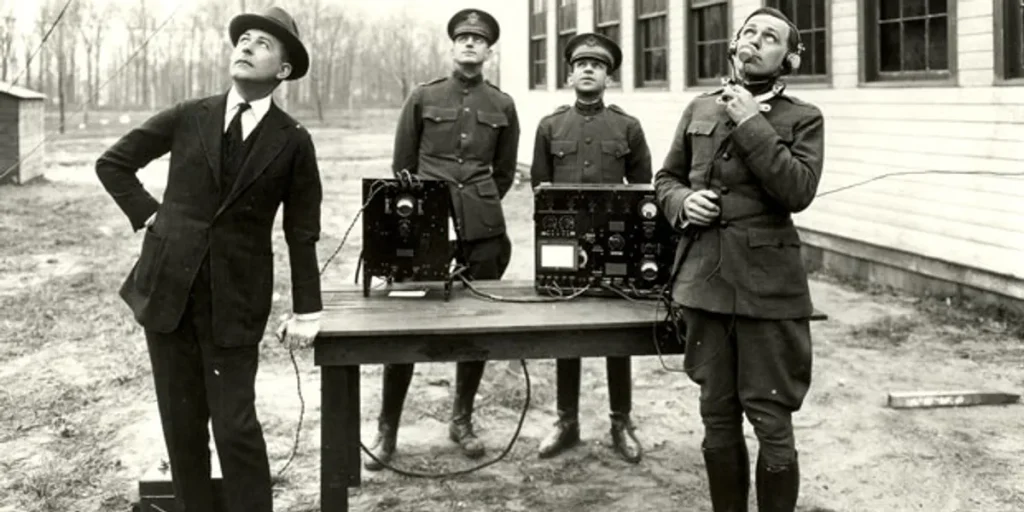
Other experimenters had broadcast before. In The Hague, Hanso Idzerda’s station PCGG put out entertainment programs in November 1919. KDKA stood out because it combined a license, a regular schedule, and a backer with a reason to keep going. Westinghouse built radio receivers, and programs gave people a reason to buy one.
The idea spread quickly. More stations went on the air, and the radio set moved from the experimenter’s workbench into the family living room. Radio became the first electronic mass medium.
How did Edwin Armstrong improve radio?
Armstrong made radio more sensitive, easier to tune, and clearer to hear. The American engineer made three changes that still matter.
In 1912 he invented the regenerative circuit, which feeds part of a receiver’s signal back into itself to make it far stronger. In 1918, while serving in the U.S. Army Signal Corps in Paris, he invented the superheterodyne receiver. It converts every incoming station to one fixed frequency that is easy to amplify and filter. RCA began selling superheterodyne sets in 1924, and the design remains the standard in radios today.
His third change was FM. AM varies the strength of the wave, and electrical storms and machinery add noise that also changes strength, so AM picks up static. FM varies the frequency of the wave instead, which ignores most of that noise. Armstrong received four FM patents in 1933. In 1939 he built the first full-scale FM station, W2XMN in Alpine, New Jersey, at a cost of more than $300,000. By that autumn the FCC had more than 150 applications for new FM stations. Armstrong spent years in patent fights with RCA and died in 1954, but his widow Marion won settlements that confirmed him as the inventor of FM.
How did the transistor make radio portable?
Before the transistor, radios ran on vacuum tubes. Tubes were bulky, hot, fragile, and wore out. Scientists at Bell Labs in New Jersey, John Bardeen and Walter Brattain, working with William Shockley, demonstrated the first transistor on December 23, 1947. It did the work of a tube in a tiny solid piece.
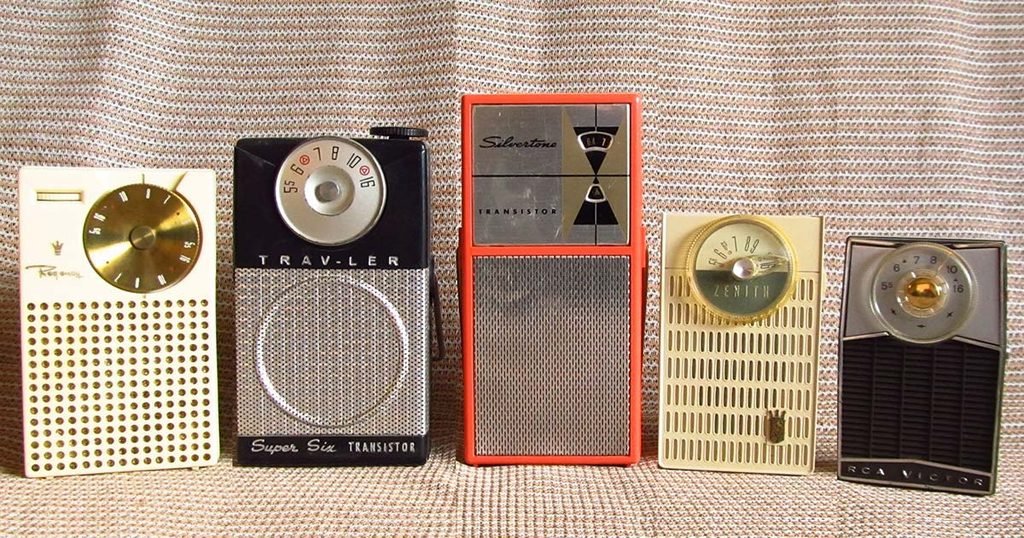
On October 18, 1954, Texas Instruments and a company called I.D.E.A. announced the Regency TR-1. It went on sale in New York and Los Angeles on November 1 for $49.95. It used four transistors, fit in a large pocket, and sold about 100,000 units in its first year. The sound was poor by today’s standards, but nothing like it had existed. In 1955 a small Japanese company released its first transistor radio, the TR-55, and later renamed itself Sony. Its TR-63, sold in the United States from December 1957, was smaller than the TR-1.
From then on, radio could go to the beach, the park, and the car. Listening was no longer tied to one room.
How did radio go digital?
For most of the 20th century, broadcast radio was analog. Digital broadcasting reached listeners in the 1990s. On June 1, 1995, Norway’s NRK launched the first Digital Audio Broadcasting (DAB) channel, and the BBC and Swedish Radio began their own broadcasts later that year. DAB is now the digital system across much of Europe.
The United States took a different route. In October 2002 the FCC approved HD Radio, which sends a digital signal on the same channel as an existing AM or FM station. If the digital signal drops, the receiver falls back to analog. Satellite radio arrived in the same years: XM launched its service in 2001, and Sirius began national service in 2002.
Digital radio gives clearer sound, extra channels, and song titles on the screen. And the same waves that Hertz made in his lab now carry Wi-Fi, Bluetooth, mobile phone calls, and GPS signals. The tools changed, but the principle did not.
Key takeaway: each leap in radio came from a better way to make, shape, or catch the wave: the spark, the steady wave, the vacuum tube, the transistor, and finally digital code.
Frequently asked questions
Who invented radio?
No single person did. Maxwell predicted radio waves, Hertz proved them in 1886 to 1888, and Marconi built the first practical wireless telegraph, crossing the Atlantic in 1901. Fessenden added voice and music in 1906. Each person supplied a piece that the next one needed.
When was the first radio broadcast?
Fessenden’s Christmas Eve program on December 24, 1906, was the first broadcast of voice and music, sent to ships at sea. KDKA’s election night broadcast on November 2, 1920, was the first scheduled broadcast from a licensed commercial station.
What is the difference between AM and FM radio?
AM changes the strength of the radio wave, and FM changes its frequency. FM sounds clearer and picks up less static. AM signals can travel farther, especially after dark, which is why it remains common for long-distance and talk stations.
What did radio use before it could carry voice?
It used Morse code. Spark transmitters sent short bursts of radio energy that operators tapped out as dots and dashes. This is why early radio was called wireless telegraphy. Ships and coastal stations were its main users.
Is radio technology still used today?
Yes. AM, FM, DAB, HD Radio, and satellite radio all still broadcast. Beyond listening, Wi-Fi, Bluetooth, mobile phones, and GPS all use radio waves, so the technology reaches far beyond the car stereo.
Conclusion
Radio communication grew in clear stages. Maxwell and Hertz showed the waves exist. Marconi made them carry Morse code across an ocean. Fessenden and the vacuum tube added voice and music, and KDKA turned that into broadcasting in 1920. Armstrong’s FM cleaned up the sound, the transistor made radios portable, and digital systems now deliver sharper stations. The core idea has not changed since 1888: shape a wave, send it, and catch it.
Recommended Articles:
Business Plan for an Online Business: A Step-by-Step Guide



[…] The History of Radio Communication Technology: From Sparks to Smartphones […]